
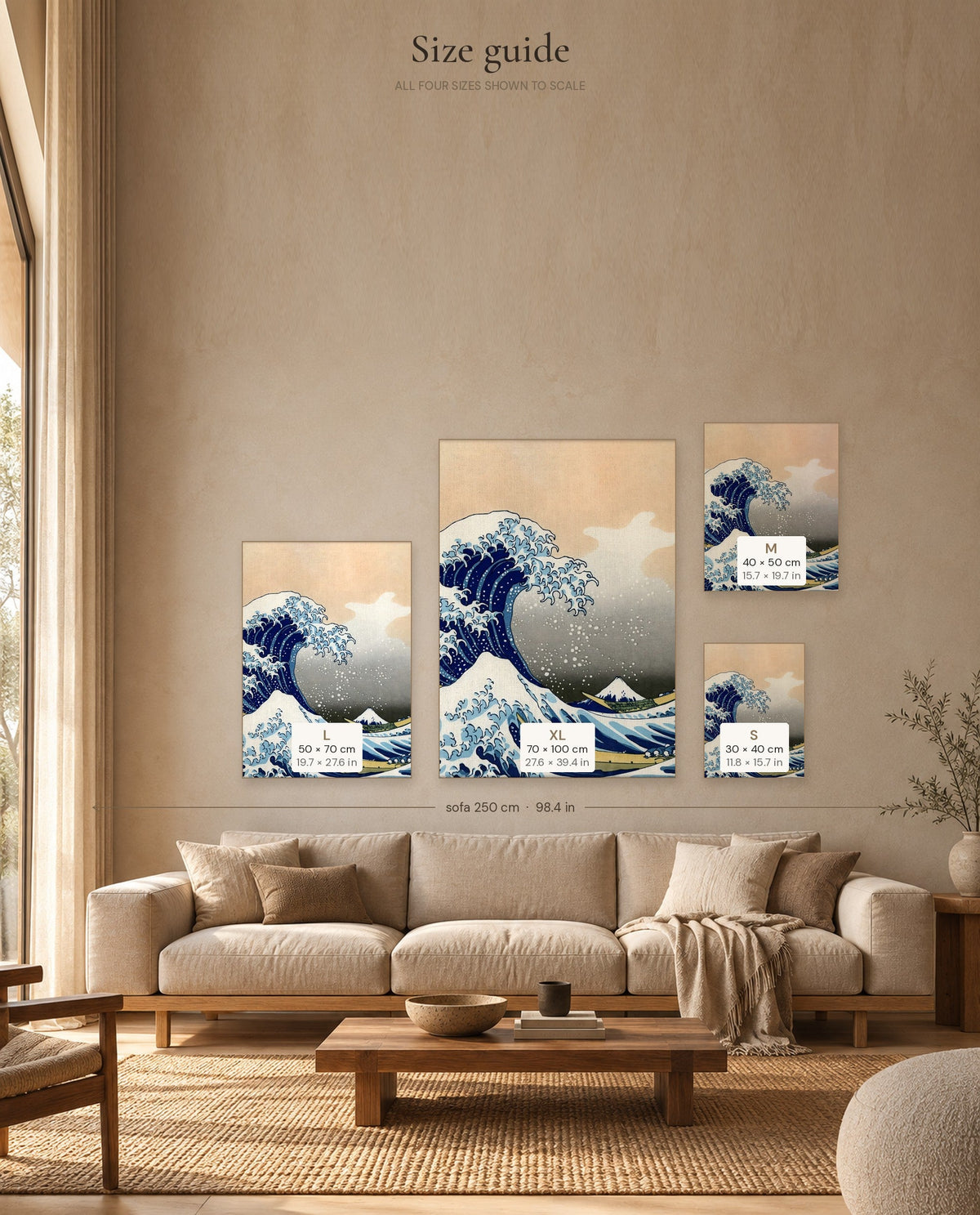
You found a print you love. Now comes the part that trips most people up: what size should it be? Go too small and the art looks lost, like a postage stamp on a big wall. Go too large and it crowds the furniture and the room feels tense.
The good news is that choosing the right wall art size is not a matter of taste alone. A few simple rules, used by designers and framers for years, will get you very close every time. This guide walks through them, with real measurements you can take with a tape measure this afternoon.
Start with the wall, not the art
Before you look at sizes, look at what the art will live with. Is it hanging above a sofa, a bed, a console table or a sideboard? Or is it going on an open wall with nothing beneath it? These two situations follow different rules.
Grab a tape measure and write down three numbers:
- The width of the furniture below the art, if there is any.
- The width of the open wall between corners, windows, doors or shelving.
- The height of the furniture, so you know where the bottom of the art can start.
Those numbers will do most of the deciding for you. Everything below builds on them.
The 2/3 rule: art above a sofa, bed or console
The most useful rule in this whole guide is this one: art above furniture should be about 2/3 to 3/4 the width of the furniture. This is the quickest answer to the question of what size wall art goes over a couch.
Some quick examples:
- An 84-inch (213 cm) sofa looks balanced with art roughly 56 to 63 inches (142 to 160 cm) wide.
- A 60-inch (152 cm) queen headboard pairs well with art around 40 to 45 inches (100 to 115 cm) wide.
- A 48-inch (122 cm) console table suits art about 32 to 36 inches (80 to 90 cm) wide.
Why does this work? Art that matches the furniture width exactly tends to feel heavy and boxed in. Art that is much narrower floats awkwardly and makes the sofa look even larger. The 2/3 to 3/4 range lets the furniture anchor the art while leaving a little breathing room at each end.
The "width" here is the total width of your arrangement, not of a single piece. If one print in your preferred size feels too narrow, you can hang two or three side by side and measure the full group, including the gaps between them. A pair of matching vertical prints above a bed is a classic, calm solution.
How high above the furniture
Leave a gap of 6 to 10 inches (15 to 25 cm) between the top of the sofa back or headboard and the bottom of the frame. Closer than that, and the art can get bumped by heads and cushions. Much higher, and it stops feeling connected to the furniture and starts drifting up the wall.
If you have a tall headboard or a low-slung sofa, use this gap as your guide rather than a fixed height from the floor.
Hang it at eye level: the 57 to 60 inch rule
For art on an open wall, or anywhere the furniture rule does not apply, the standard is to place the center of the artwork about 57 to 60 inches (145 to 152 cm) from the floor. This is roughly average eye level, and it is the height many galleries and museums use.
Note that it is the center of the art, not the top or the nail. Here is how to find the nail position:
- Measure the height of the framed piece and divide by two.
- Add that number to 57 or 60 inches. That is where the top of the frame should sit.
- Measure how far the hanging wire or hook sits below the top of the frame, and subtract it. That is where the nail goes.
The most common mistake in home decorating is hanging art too high. If your pieces feel like they are floating near the ceiling, try lowering them. The room will instantly feel more grounded.
When art hangs above furniture, the 6 to 10 inch gap usually takes priority. In practice the two rules often land in nearly the same spot.
Go bigger on empty walls
An open wall with no furniture below needs a different approach. There is nothing to measure against, so people tend to buy too small. A modest print alone on a large wall can make the whole room feel unfinished.
As a rough guide, aim for art that fills a good share of the open wall, often somewhere around half to two-thirds of the wall width once you account for surrounding doors and windows. On a large wall, that usually means one of these options:
- One large statement piece, which suits a calm, minimal room.
- A pair or trio of matching sizes, hung in a line.
- A gallery wall, treated as one large shape.
If you are unsure between two sizes, choose the larger one. A generous piece of art almost always looks more intentional than a small one, and in a Japandi or minimal room, a single large image with plenty of wall around it is often all the decoration a space needs. Our Japandi living room ideas show how much one well-chosen piece can do.
Narrow walls, like the strip beside a doorway or between two windows, are the exception. A tall, vertical print suits these spaces well and draws the eye upward.
Gallery walls: spacing and planning
Gallery walls look effortless when they work, but they are planned carefully. Our step-by-step guide to creating a calm gallery wall covers layout in detail. Two rules keep any gallery wall tidy:
- Keep spacing consistent, about 2 to 3 inches (5 to 8 cm) between frames. Tighter gaps make the group read as one piece. Wider gaps make it look scattered.
- Treat the whole group as one artwork. Apply the 2/3 rule to the total width over furniture, and center the whole group around 57 to 60 inches on an open wall.
A few more tips that help:
- Start with the largest piece near the center and build outward.
- Use matching or closely related frames for a calmer look. For example, all natural oak, or all black.
- Keep a common edge if you want structure: align all the tops, all the bottoms, or a central horizontal line.
- Repeat a color or theme so the pieces feel like they belong together.
Test before you drill: the painter's tape method
This is the single easiest way to avoid mistakes. Before you buy or hang anything, make a template:
- Cut kraft paper or newspaper to the exact size of the framed art you are considering. Include the frame, which adds width.
- Tape it to the wall with painter's tape, which will not damage the paint.
- Leave it up for a day. Look at it from the doorway, from the sofa and from across the room.
- Adjust the size or position until it feels right, then mark the nail spot through the paper.
You can also skip the paper and outline the shape directly with painter's tape. Either way, seeing the real size at real scale beats any amount of guessing. Templates are especially helpful for gallery walls, because you can rearrange the paper shapes freely before committing a single nail.
Frame, orientation and room style
Size is not only about the art itself. A few other choices affect how big a piece feels on the wall:
- Frames add visual weight. A black or dark wood frame makes a piece read as larger and more defined. A white or natural oak frame feels lighter and softer.
- Canvas has no frame edge, so it can feel more modern and slightly more substantial for the same image size.
- Orientation follows the space. Horizontal art suits long furniture like sofas and beds. Vertical art suits narrow walls, hallways and tall ceilings.
- Calm rooms favor fewer, larger pieces. In Japandi and minimalist interiors, one well-chosen image with space around it often feels better than many small ones.
At credō, every design in our wall art collection comes as an art print or canvas in 5 sizes, with frame options in black, natural oak, dark wood or white, or unframed if you prefer your own. A bold horizontal piece like the Kanagawa Wave art print works well over a sofa, while a softer canvas such as Akari Zen Garden suits a bedroom wall. If you are drawn to Japanese woodblock designs, ukiyo-e explained is a short guide to where they come from.
A quick cheat sheet
- Over furniture: art is 2/3 to 3/4 of the furniture width.
- Gap above furniture: 6 to 10 inches (15 to 25 cm).
- Eye level: center of art at 57 to 60 inches (145 to 152 cm) from the floor.
- Gallery walls: 2 to 3 inches (5 to 8 cm) between frames.
- Empty walls: go bigger than you think.
- Always: test with a painter's tape template first.
Frequently asked questions
What size wall art goes above a couch?
Aim for art about 2/3 to 3/4 the width of the sofa. An 84 in (213 cm) sofa suits art roughly 56-63 in (142-160 cm) wide, either as one piece or as a group measured edge to edge.
How high should you hang wall art?
On an open wall, center the art about 57-60 in (145-152 cm) from the floor. Above furniture, leave 6-10 in (15-25 cm) between the top of the furniture and the bottom of the frame.
What size art goes above a queen bed?
A queen headboard is about 60 in (152 cm) wide, so art around 40-45 in (100-115 cm) wide looks balanced. A matching pair of vertical prints works well too.
Is it better for wall art to be too big or too small?
Slightly too big is almost always better. Small art on a large wall looks lost and makes the room feel unfinished. If you are between two sizes, choose the larger one.
How much space should be between frames?
Leave about 2-3 in (5-8 cm) between frames and keep the gaps consistent. Tighter gaps read as one group, while wider gaps start to look scattered.
The right size makes even a simple print look considered and calm. Measure your wall, make a quick paper template, and trust the rules. If you are ready to choose a piece, browse our wall art. Orders over $149 ship free, prints ship in 3-7 business days, and you have 30 days for easy returns if the size is not quite right on your wall.


Share:
How to Create a Japandi Bedroom
Bedding Fabric Guide: Thread Count, Weaves, Silk, Tencel and Down Explained