
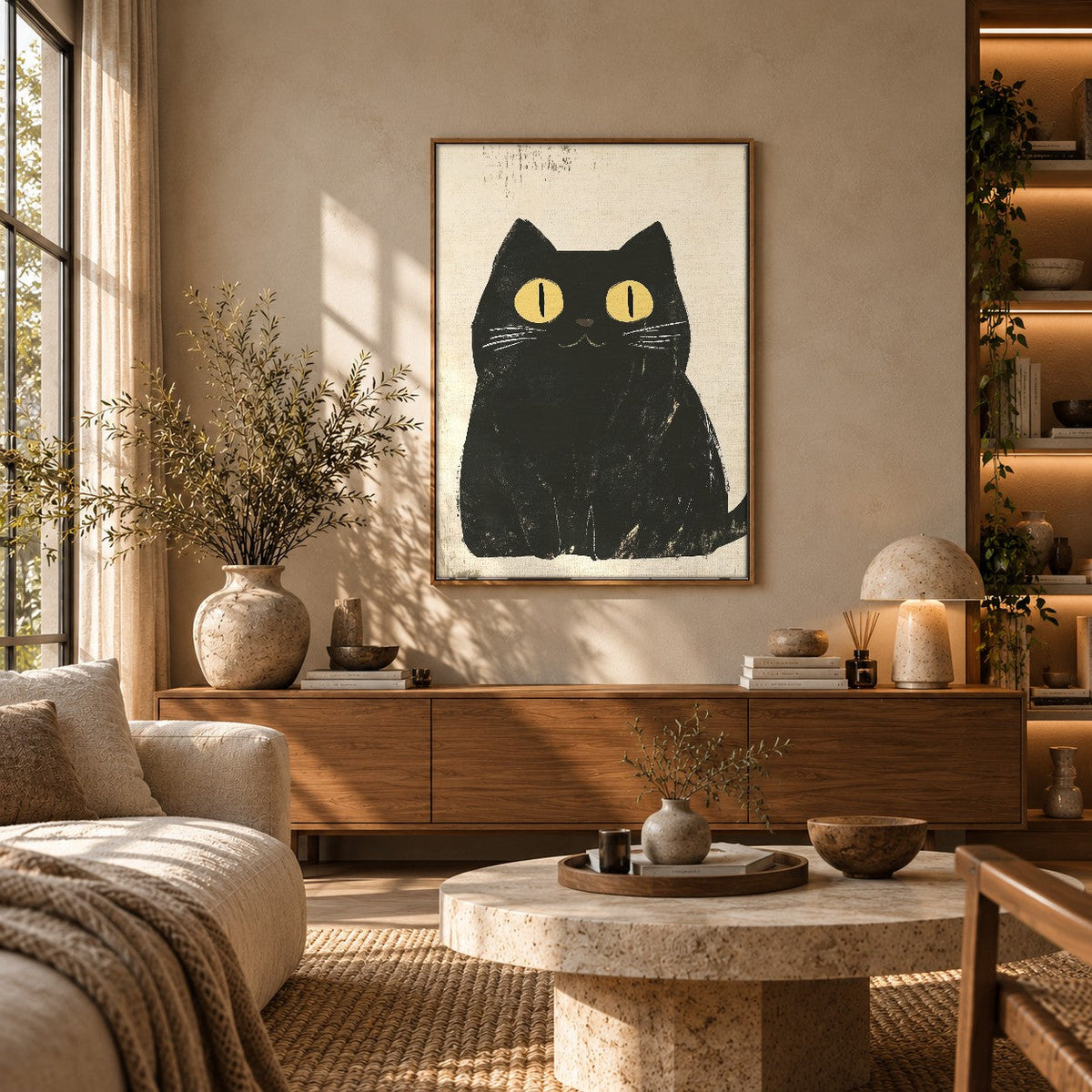
A gallery wall can be one of the most personal things in a home. It can also be one of the most chaotic. Too many frames, mixed finishes and uneven gaps can make a wall feel restless rather than welcoming.
A Japandi gallery wall takes a different approach. It uses fewer pieces, more space between them, and a quiet, consistent palette. The result feels curated and calm, like a small exhibition rather than a collage. Here is how to plan and hang one, step by step.
Start with the feeling, not the frames
Before you buy anything, decide what the wall should do for the room. A gallery wall above a sofa sets the tone for a whole living space. One in a hallway is something you pass by. One above a bed should feel especially restful.
Ask yourself:
- Should this wall feel quiet and meditative, or a little more lively?
- Which colors already live in the room: wood tones, textiles, ceramics?
- Is there a theme that ties the pieces together, such as nature, landscapes, line drawings or Japanese prints?
Japandi style, which blends Japanese minimalism with Scandinavian warmth, leans toward natural subjects, soft neutrals and plenty of negative space. If you are new to the style, our introduction to what Japandi is is a helpful starting point.
Choose fewer, larger pieces
The single biggest difference between a busy gallery wall and a calm one is the number of pieces. A Japandi wall rarely needs more than three to five frames. Larger artworks with generous space around them read as intentional, while many small pieces can feel scattered. If you are unsure how big to go, our guide to choosing the right wall art size has simple rules and measurements.
Some reliable layouts:
- The pair. Two same-size pieces side by side. Simple, balanced and ideal above a bed or console.
- The trio. Three pieces in a row, or one larger piece flanked by two smaller ones. Odd numbers often feel natural to the eye.
- The asymmetric five. One anchor piece with four smaller frames arranged around it. Works well on a large wall above a sofa.
- The grid. Four or six identical frames in a tight grid. Very structured, very calm, especially with a consistent theme.
Keep a consistent palette and frame finish
Cohesion is what makes a gallery wall feel calm. The easiest way to get it is to repeat something across every piece.
Frames
Choose one frame finish and use it throughout. Natural oak feels warm and Scandinavian. Black frames add definition and a slightly more graphic look. Dark wood feels grounded and rich, while white frames almost disappear on a light wall. Mixing finishes can work, but it takes a confident eye, and a single finish is far more forgiving.
Our wall art is available as an art print or a canvas in 5 sizes, with black, natural oak, dark wood or white frames, or unframed. That makes it straightforward to keep every piece in the same finish, even when the artworks themselves differ.
Print or canvas?
Art prints behind glass and frame feel refined and gallery-like. Canvas has a softer, more textured surface with no glare, which can suit a bedroom or a wall opposite a bright window. Either works on its own; if you combine them, keep the sizes and frame finish consistent so the wall still reads as one considered group.
Color
Pick two or three colors to carry through the artwork. Ink black, warm cream, muted indigo and soft clay all sit well together. A classic like the Kanagawa Wave wall art brings blue and cream into a room, while the Kuro Neko wall art adds a graphic black accent with a touch of personality. If you love Japanese prints, ukiyo-e explained covers the artists and themes behind them.
Plan it on the floor first
Hanging frames without a plan usually means extra holes in the wall. Instead, lay everything out before you pick up a hammer.
- Measure the wall space you want to fill, and mark that area on the floor with painter's tape.
- Arrange the frames inside the taped area. Move them around until the balance feels right. Take a photo of each version so you can compare.
- Make paper templates. Trace each frame onto kraft paper or newspaper and cut it out. Mark where the hanging hardware sits on the back of each frame.
- Tape the templates to the wall with low-tack tape. Live with them for a day or two. Adjust as needed.
- Hang through the templates. Drive your nail or hook through the marked hardware point, then tear the paper away.
This step feels slow, but it is the most reliable way to get a gallery wall right the first time.
Get the spacing and height right
Two measurements make the biggest difference to how polished a gallery wall looks.
Space between frames
Leave about 2 to 3 inches (5 to 8 cm) between frames. Too tight and the pieces crowd each other. Too wide and they stop reading as a group. For a calm Japandi look, sit at the upper end of that range and keep the gaps consistent. Even spacing is what makes a wall look deliberate.
Hanging height
Aim for the center of the whole arrangement to sit around 57 to 60 inches (145 to 152 cm) from the floor. This roughly matches eye level and is the same principle many galleries use. Treat the whole group as one piece of art and center it on that line, rather than centering each frame individually.
Above furniture
When hanging above a sofa, bed or sideboard, the arrangement should relate to the furniture below. Leave a modest gap above the furniture so the art and the piece below feel connected, and keep the overall width a little narrower than the furniture so it does not overwhelm it.
Let the wall breathe
Negative space is not empty space in a Japandi room. It is part of the design. The blank wall around your gallery is what gives each piece room to be seen.
- Do not fill every inch. Leave clear wall on all sides of the arrangement.
- Edit ruthlessly. If a piece does not fit the palette or the mood, save it for another room.
- Use a central line. Aligning the frames to a shared horizontal centerline, or along a top or bottom edge, creates instant order.
- Consider a mirror. A single round or organic mirror can replace one frame and add light and softness to the group.
Finish with light and objects
A gallery wall feels complete when it connects to the rest of the room. A warm table lamp on a console below, or soft lighting nearby, gives the artwork a gentle glow in the evening. A simple ceramic bowl, a small stack of books or a branch in a vase can echo the colors in the art and pull the whole vignette together.
Keep these objects few and low. The art is still the focus.
Common mistakes to avoid
- Hanging too high. It is the most common issue. When in doubt, go lower.
- Uneven gaps. Small differences in spacing are surprisingly visible. Measure every gap.
- Too many small frames. They can look cluttered. Scale up and edit down.
- Mismatched finishes by accident. If you mix, do it on purpose. Otherwise keep one finish.
- Skipping the plan. Templates take an hour and save a wall full of extra holes.
Frequently asked questions
How many pictures should be on a gallery wall?
For a calm, Japandi-style wall, three to five pieces is usually enough. Fewer, larger pieces with space around them look more considered than many small frames.
How far apart should frames be on a gallery wall?
Leave about 2-3 in (5-8 cm) between frames, and keep every gap the same. For a calmer look, stay at the wider end of that range.
How high should a gallery wall be hung?
Treat the whole arrangement as one piece and center it about 57-60 in (145-152 cm) from the floor. Above a sofa or sideboard, keep the group close enough to the furniture that the two feel connected.
Do all the frames on a gallery wall need to match?
No, but one frame finish is the easiest way to make different artworks look like a set. If you mix finishes, repeat each one at least twice.
How do you plan a gallery wall without extra holes?
Cut paper templates to the size of each frame, tape them to the wall with painter's tape and adjust until the layout feels right. Mark the nail position on each template, then hang through the paper.
A calm gallery wall is less about filling space and more about choosing well. Start with a handful of pieces you genuinely love, give them room, and let them settle into the room over time. When you are ready, explore our wall art collection to find prints and canvases in matching frames, with free shipping on orders over $149 and 30-day easy returns.


Share:
Linen vs Cotton vs Egyptian Cotton Bedding: Which Is Right for You?