
Tea Culture
The Japanese Tea Ceremony: A Beginner's Guide to Bringing the Ritual Home
There is a four-hundred-year-old idea at the heart of Japanese tea culture: the way you prepare something changes the way it tastes. Not chemically — psychologically. When you slow down, use beautiful objects, and treat the act of making tea as something worth doing well, the tea is better. So is the fifteen minutes surrounding it.
A Brief History of the Tea Ceremony
Tea arrived in Japan from China around the 9th century, brought by Buddhist monks who used it to stay alert during long meditation sessions. For centuries it remained confined to temples and the aristocracy.
Everything changed in the 16th century when a tea master named Sen no Rikyu transformed the ceremony from a display of wealth into a philosophy of restraint. He stripped out the gold, the silk, the ornate vessels, and replaced them with smaller rooms, simple clay bowls, and the principle that a crack in a ceramic cup was not a flaw — it was evidence of a life being lived.
His four principles still define Japanese tea practice today:
和 Wa
Harmony
敬 Kei
Respect
清 Sei
Purity
寂 Jaku
Tranquility

The Philosophy of Wabi-Sabi in Tea
A wabi-sabi tea bowl is not perfectly round. The glaze is not uniform. These qualities are not tolerated — they are celebrated. Each bowl is understood to be unique, unrepeatable, and more beautiful for its irregularities.
This is why authentic Japanese ceramics feel so different from mass-produced teaware. A Ru Cellar ceramic tea set carries the crackle glaze created unpredictably in the kiln — no two pieces are identical. This is not a defect. It is the whole point.
The Key Elements of a Tea Set
The Teapot
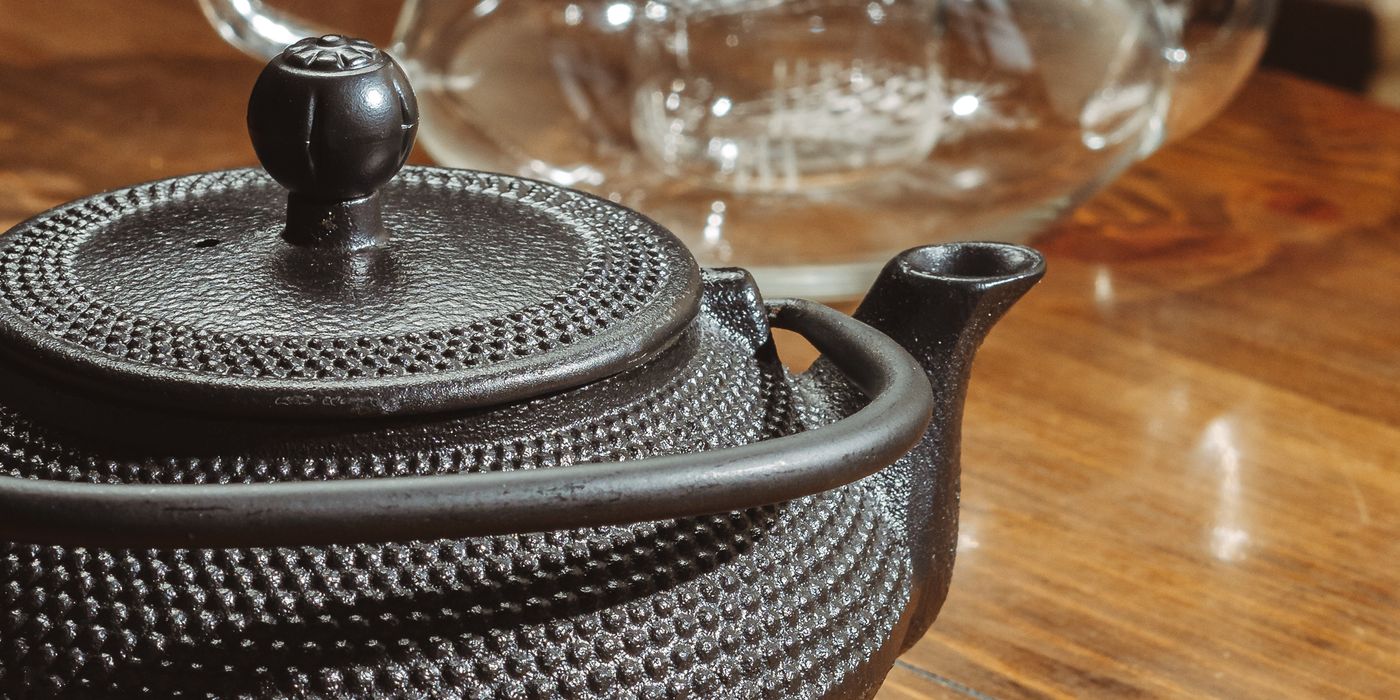
The most important vessel. Often a side-handle design, allowing for precise, controlled pouring. A good teapot has weight. It pours cleanly. It fits the hand in a way that slows you down.
The Teacups
Japanese teacups are smaller than Western cups — designed for multiple short pours rather than one large serving. Each pour is an act of attention toward the person receiving it.
The Fair Cup
Tea is poured into the fair cup first, then distributed evenly. A small object with a clear purpose: equity. Every guest receives the same quality of tea.
The Tea Tray
The tray grounds the ceremony. It catches drips, creates a defined space for the ritual, and turns a functional object into a quietly beautiful one.


How to Create a Daily Tea Ritual at Home
The formal Japanese tea ceremony can last up to four hours and requires years of study. A home practice requires neither. What it requires is a decision: that for this specific period of time, making and drinking tea is the only thing happening.
Prepare the space. Clear the surface. Remove everything that is not part of the ritual.
Heat the water properly. Green tea at 70-80°C. Oolong at 85-90°C. Black tea at 95-100°C. Boiling water makes green tea bitter.
Warm the teapot and cups. Pour hot water in, swirl, discard. Cold ceramics steal heat from the tea immediately.
Steep with intention. Set a timer. Green teas: 1-2 minutes. Black teas: 3-4 minutes.
Pour and sit. No phone. No reading. Just the tea, the cup, and whatever is outside the window.

There is a reason the Japanese tea ceremony has survived for four centuries. It works. The ritual of slowing down, using beautiful objects, and giving your full attention to a single act remains one of the most effective ways humans have found to return to themselves.
Share:
What is Japandi
Natural Materials