
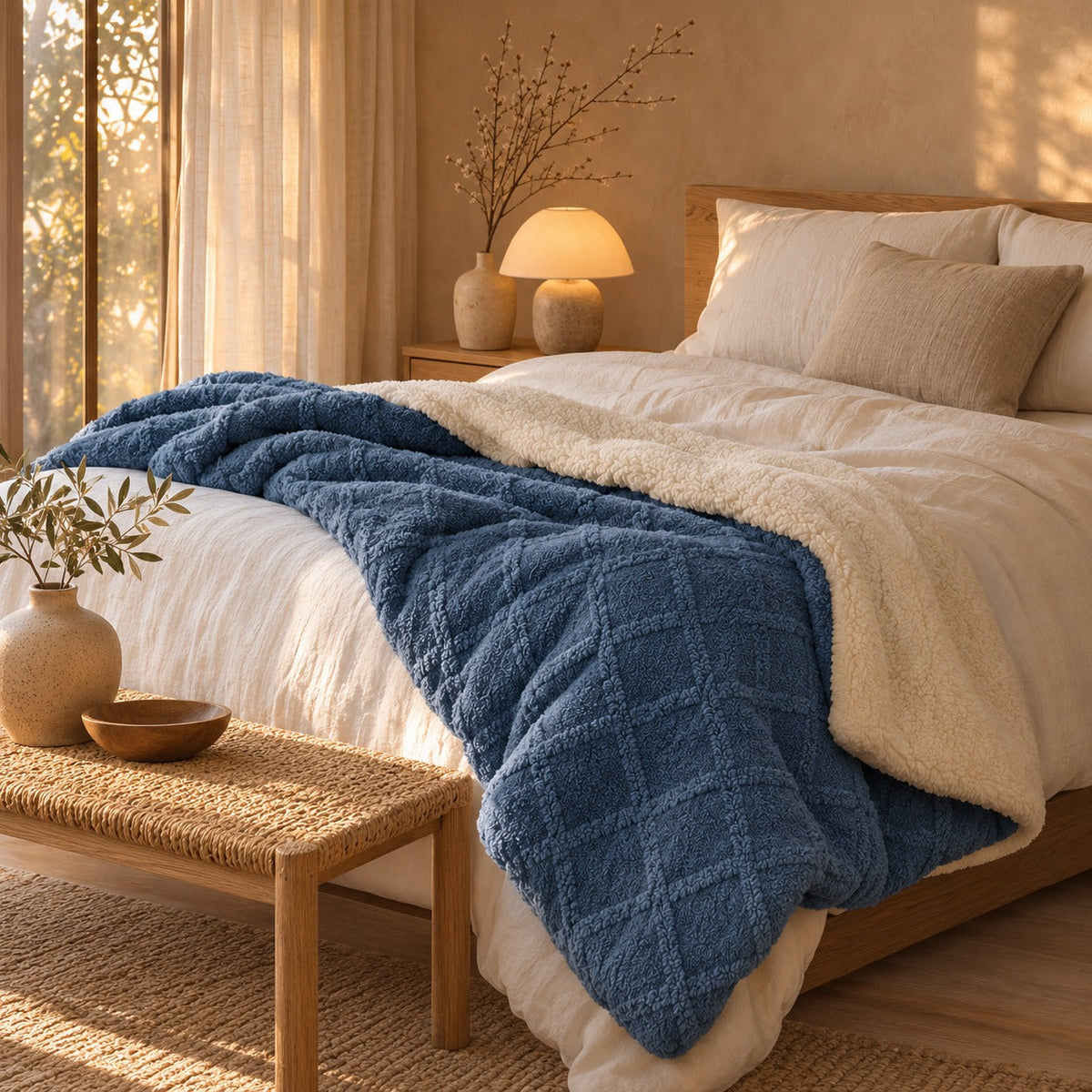
Weighted blankets have become one of the most searched bedding items of the past few years, and for good reason: many people love the feeling of being gently pressed into the bed. But a weighted blanket is not the only way to get that heavy, tucked-in feeling, and it is not right for everyone. A thick, dense winter blanket gives a softer version of the same comfort, covers the whole bed, and is easier to live with every night.
This guide explains the real difference between a weighted blanket and a heavy blanket, what the research actually says, who should skip weighted blankets, and how to choose the right one for how you sleep.
The short answer
- Choose a weighted blanket if you specifically want deep, firm pressure, you sleep cool, and you are happy with a smaller blanket that covers you rather than the bed.
- Choose a heavy blanket if you want a cozy, cocooning weight without feeling pinned down, you share the bed, or you want one blanket that also looks good on the bed during the day.
What a weighted blanket is
A weighted blanket is filled with small, heavy material sewn into a grid of pockets so it stays evenly spread. The fill is usually plastic pellets or glass microbeads. Glass is denser, so it needs less volume for the same weight, which keeps the blanket slimmer.
- Typical weight: 5 to 30 lb (2 to 14 kg), most often 12 to 20 lb (5 to 9 kg).
- How to pick the weight: the common starting point is about 10% of your body weight, so roughly 15 lb (7 kg) for a 150 lb (68 kg) adult. Sleep doctors at Baylor College of Medicine describe this as a rough guide and suggest not going above 25 lb (11 kg) for most people.
- Size: weighted blankets are usually sized to the person, not the mattress, so the weight rests on your body instead of hanging off the sides. A typical adult size is around 48 x 72 in (122 x 183 cm) or 60 x 80 in (152 x 203 cm).
What a heavy blanket is
A heavy blanket gets its weight from thick, dense materials rather than beads: a substantial fill, a plush sherpa or fleece layer, or a tightly woven cover. It weighs less than a weighted blanket, usually 4 to 10 lb (2 to 4.5 kg), but noticeably more than an ordinary comforter, so it settles over you with a soft, even pressure.
Because it is sized like regular bedding, a heavy blanket covers the whole mattress, drapes over the sides and works as the top layer of the bed. It is also easier to shake out, fold and wash at home.
Weighted vs heavy blanket at a glance
| Weighted blanket | Heavy blanket | |
| Weight | 5-30 lb (2-14 kg) | 4-10 lb (2-4.5 kg) |
| Feel | Firm, deep pressure | Soft, cocooning weight |
| Size | Sized to your body | Sized to your bed |
| Warmth | Can trap heat | Warm, depends on fill |
| Sharing a bed | Usually one per person | One blanket for two |
| Washing | Often needs a large or commercial machine | Large home machine, gentle cycle |
What the research says
It is worth being honest here, because weighted blankets are often marketed with big promises. The evidence is promising but limited.
- A 2020 randomized trial in Sweden, published in the Journal of Clinical Sleep Medicine, gave adults with insomnia and a psychiatric condition either a heavy chain blanket (about 13 to 18 lb, 6 to 8 kg) or a light one for four weeks. The weighted group reported clearly better sleep.
- Reviews of the wider research find that weighted blankets may help some people feel calmer, but that there is not yet enough strong evidence to call them a treatment for insomnia or anxiety.
- Results vary a lot from person to person. Some people sleep better straight away, others find the weight uncomfortable or too warm.
In short: if you enjoy the feeling, it is a pleasant addition to your bedtime routine. It is not a substitute for medical advice if you are struggling with sleep.
Who should skip a weighted blanket
- Babies and young children. Do not use weighted blankets for children under 3, and supervise closely for young children, according to Baylor College of Medicine.
- Anyone who cannot easily lift it off. If a person cannot remove the blanket on their own, they should not sleep under it.
- People with certain health conditions. If you have sleep apnea, a breathing or circulation condition, or limited mobility, check with your doctor first.
- Hot sleepers. Dense fill holds heat. If you already wake up warm, a lighter, breathable layer may serve you better.
For these sleepers, a heavy blanket is often the gentler middle ground: you still get the weight and warmth, without the firm pressure.
Our heavy blanket: Aizome

The Aizome Heavy Sherpa Comforter is our answer for people who want that tucked-in feeling without a weighted blanket. To be clear, it is not a weighted blanket: there are no beads inside. Its weight comes from a dense fill and a thick sherpa fleece reverse, about 8.8 to 9.9 lb depending on size, roughly twice a standard comforter.
- Two sides. A raised diamond jacquard on top in washed indigo or heather gray, and a thick cream sherpa fleece underneath for the coldest nights.
- Bed-sized. Twin/Full 59 x 79 in (150 x 200 cm), Queen 79 x 91 in (200 x 230 cm) and King 87 x 94 in (220 x 240 cm). Choose King if you want extra drop over the sides of a queen.
- Materials. Polyester jacquard cover, faux lamb wool sherpa reverse and polyester fill.
- Easy care. Machine wash cold on a gentle cycle in a large-capacity machine and tumble dry low. Skip fabric softener on the plush side.

Washed indigo has a long history in Japanese textiles, which is where the name comes from: aizome means indigo dyeing. The color sits beautifully against oak, linen and warm white walls, so the blanket looks calm and intentional when it is folded at the foot of the bed during the day.
How to layer a heavy blanket
- Cold winter nights: sheet, duvet, then the heavy blanket on top, sherpa side down for the most warmth.
- Cool autumn and spring nights: sheet and heavy blanket only, without the duvet.
- Daytime: fold it in thirds across the foot of the bed. It adds texture and makes the bed look finished.
Pair it with smooth, breathable sheets so the bed does not feel too warm. Our Asanagi Egyptian Cotton Bedding Set works well underneath, and a supportive pillow like the Fuwa Natural Goose Down Pillow Set completes the bed. For more on fabrics, read our bedding fabric guide and our 7 bedroom rules for deeper sleep.
FAQ
Is a heavy blanket the same as a weighted blanket?
No. A weighted blanket is filled with beads or pellets and usually weighs 5 to 30 lb. A heavy blanket gets its weight from thick materials and usually weighs 4 to 10 lb. Both give a pressing, cozy feeling, but a weighted blanket is much firmer.
How heavy should a weighted blanket be?
A common starting point is about 10% of your body weight. Most adults should not go above 25 lb. If it feels wrong, it is more likely too heavy than too light.
Can couples share a weighted blanket?
It is possible, but the weight is designed for one person and gets split unevenly between two. Many couples use two individual weighted blankets or one bed-sized heavy blanket instead.
Are heavy blankets too hot?
They are warmer than a standard comforter. If you sleep warm, use one on top of a breathable sheet without a duvet, or keep it for the coldest months.
How heavy is the Aizome comforter?
About 8.8 to 9.9 lb depending on size. It is a heavy comforter, not a weighted blanket.
Whichever you choose, the goal is a bed that feels like a quiet, safe place to land. Browse our pillows and comforters or the full bedding collection, with free US shipping on orders over $149.

Share:
How to Create a Calm Gallery Wall (Japandi Style)